SHOP NOTE · 2026-09-04
Which CNC Finish Should You Spec? Anodize vs Plating vs Passivation
Newtop Group
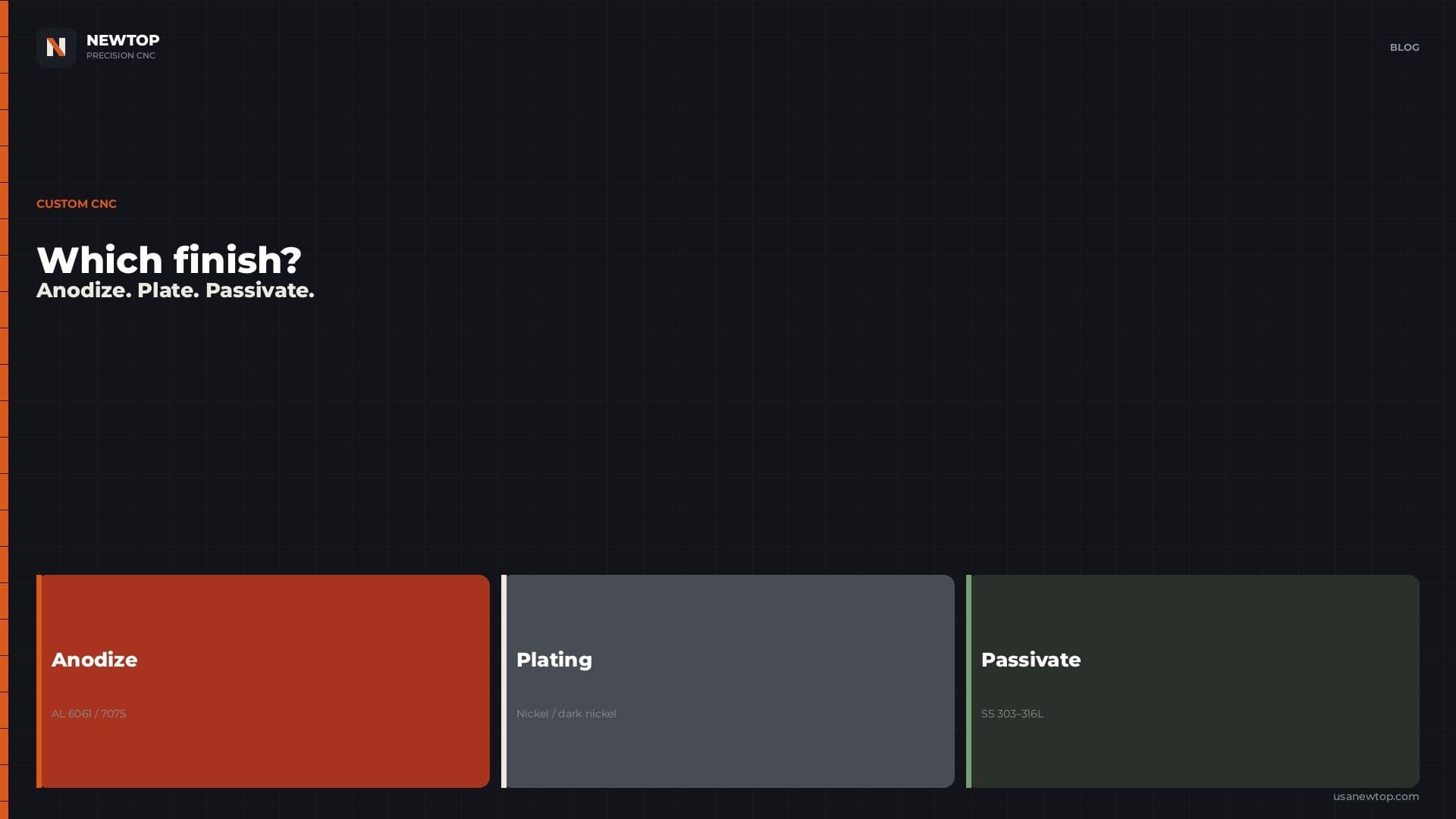
The best CNC finish is the one that matches the alloy and the job — not the one that looks nicest on a sample board.
Anodize aluminum when you need wear or color. Plate when the surface has to be harder or look different from the base metal. Passivate stainless after every machining lot. Heat-treat only when strength is the requirement. Newtop machines custom parts in aluminum, stainless, brass, titanium, and POM/PC, then runs anodize, plating, passivation, and heat treatment against the same drawing.
What is a CNC surface finish?
A CNC surface finish is the treatment applied after the part is cut. Machining gives you size, threads, and datums. Finish gives you corrosion resistance, wear, color, and sometimes a small change in diameter. If the finish is not on the print, the quote is for a different part.
Which finish should I use?
Use this as the default map:
Aluminum 6061 or 7075 → anodize. Type II for color and light corrosion. Type III hard anodize when the face will rub. Black anodize for camera and UAV parts that cannot throw glare.
Stainless 303, 304, 316L, 17-4PH → passivate. Always. 316L if the part sees weather or spray chemicals. 17-4PH if it also has to be strong — call the heat-treat condition on the drawing.
Brass → leave bright, or plate when the contact face needs a different wear or color.
Titanium → machine it for mass. Add finish only if the print calls it.
POM / PC → do not plate. These are insulating or low-friction seats next to metal.
As-machined is correct when the part lives inside a housing and will not be worn or seen. It is the fastest path. It is not a finish. It is the absence of one.
Type II or Type III anodize — what is the difference?
Type II anodize is the standard decorative and corrosion layer. It takes color. Use it on visible housings, knobs, and fleet-matched parts.
Type III hard anodize is thicker and harder. Use it on rotor hubs, rails, and any aluminum face that will see abrasion. It can grow size. Mask threads and precision bores or the fit moves.
Black is not decoration on a camera drone. It cuts stray light.
Does plating change the dimension?
Yes. Plating adds thickness. A ±0.002 mm register will not survive an unplanned nickel coat. If a bore, thread class, or seating face is critical, write the max build-up and which features to mask. Nickel and dark nickel are the usual callouts when aluminum needs a harder skin or stainless is too heavy.
Why passivate stainless after CNC?
Cutting leaves free iron on the surface. Passivation removes it so the part does not stain in the field. It is inexpensive. Skip it and a 304 pin can look failed in a week even when the size is perfect.
When is heat treatment a finish — and when is it not?
Heat treatment changes strength, not color. It belongs on 17-4PH and on steels that are not done until the condition is named. Do it before final size-critical finishing when the part has to hold tolerance after the oven.
What should an RFQ include so the finish is quoted?
Send all of this with the drawing or STEP:
Alloy and temper. Finish name and spec (Type II, Type III, color, plating metal). Features to mask. Allowed thickness if a fit will change. Quantity now and at rate. Material cert, yes or no. CMM report after finish, yes or no.
Newtop quotes custom CNC work in one business day. Swiss turning holds ±0.002 mm on pins, shafts, and registers. Milling holds ±0.01 mm on brackets and housings. Lots can be checked on a ZEISS CONTURA CMM (0.9 μm). Reports ship with the parts when the print asks.
FAQ — CNC finishes
What finishes does Newtop offer?
Anodize, plating, passivation, and heat treatment, on aluminum, stainless, brass, titanium, and engineered plastics.
Is hard anodize better than regular anodize?
It is better for wear. It is not automatically better for color or cost. Use Type III on rubbing faces. Use Type II when you need color and basic corrosion resistance.
Can you match a color across a production lot?
Yes if the print names the color and you send a chip when the fleet already exists. Color is a spec, not a guess.
Should every prototype be finished?
No. First articles can ship as-machined so you lock size first. Put the production finish on the revision that will fly or ship.
How fast can a finished custom part be quoted?
Drawing to quote in one business day. Prototypes can start in as little as 48 hours depending on alloy and finish queue.
Request a quote: https://www.usanewtop.com/rfq
— Newtop Group
Precision CNC machining. Custom metal parts, machined properly.
Request for quote
Need a part like this machined?
Reviewed by an engineer within 1 business day. AL · SS · brass · titanium · to ±0.002mm.
Request a quote