SHOP NOTE · 2026-09-09
Swiss CNC Turning vs CNC Lathe: When ±0.002 mm Holds on Pins and Shafts
Hui
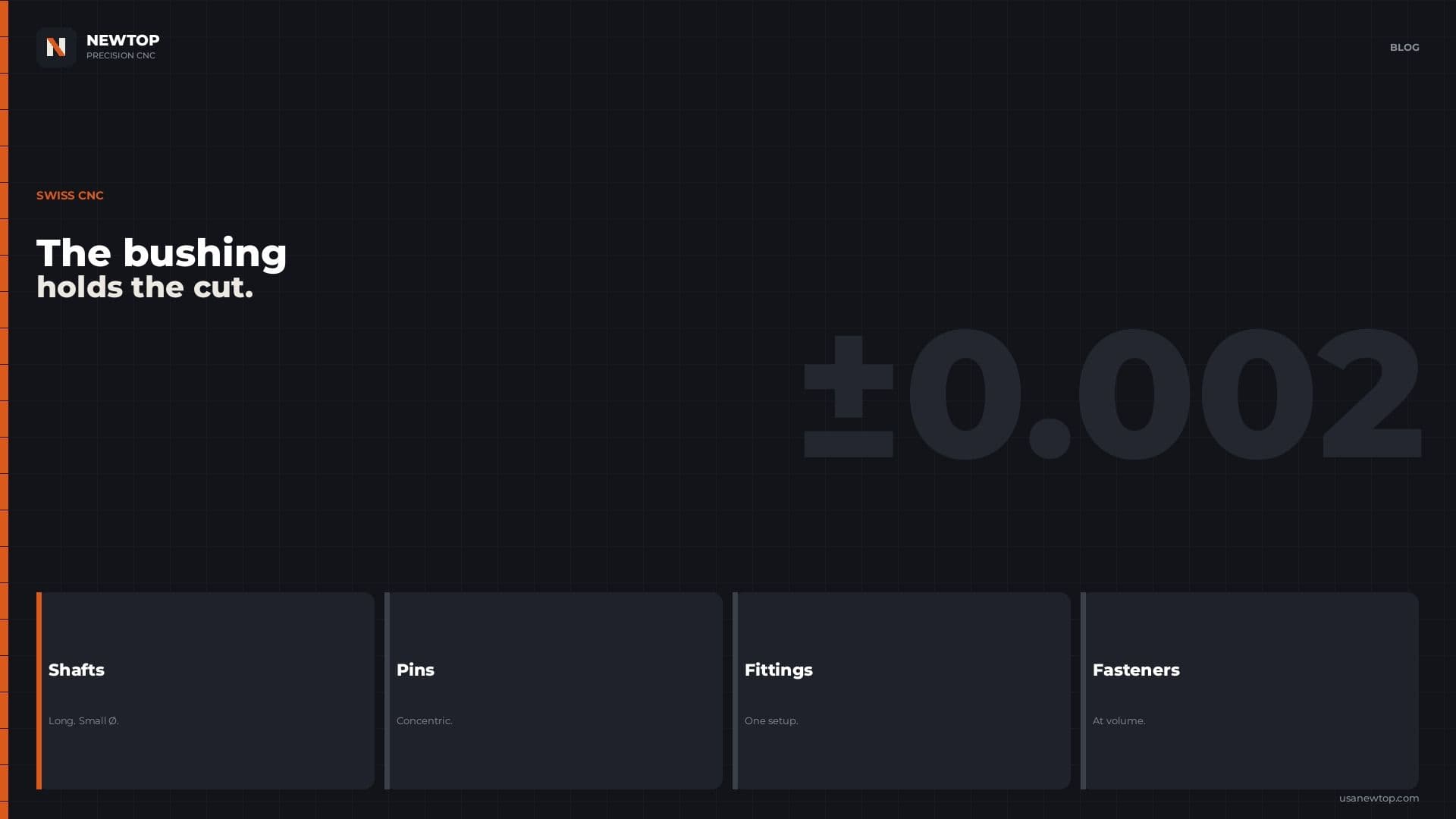
Swiss CNC turning is bar-fed turning on a sliding headstock. A guide bushing holds the bar at the tool so long, small-diameter parts stay straight.
It is not a fancier CNC lathe. It is a different process. On a Swiss-type machine the bar is supported a few millimeters from the cut. The headstock slides. The part does not whip. That is why shafts, pins, fittings, connectors, and fasteners come off a Star, Citizen, or Tsugami straighter than they come off a chucker.
Newtop runs Swiss CNC turning for small-diameter parts at volume. Published band: ±0.002 mm on the features that require it. Materials: aluminum, stainless, brass, titanium, POM/PC. Prototypes in 48 hours. Drawing to quote in one business day. Every lot measured. Reports in the box.
What is Swiss CNC turning?
Swiss CNC turning is bar-fed turning with a sliding headstock and a guide bushing at the cut.
Bar in. Bushing at the tool. Live tools for holes, flats, and threads. Sub-spindle for the back. Part drops. Next bar is already in the bushing.
A 4 mm pin that is 40 mm long is a problem on a standard CNC lathe. It is a normal Swiss job.
Use Swiss when three things are true: small diameter, high length-to-diameter, and journals, threads, and grooves that must stay concentric in one setup.
Swiss lathe vs CNC lathe — which one?
A Swiss-type lathe holds the bar in a guide bushing at the tool. Use it for small diameter and high L/D. Newtop work on Swiss: shafts, pins, fittings, fasteners, valve stems, contact pins, arrow points. Published tolerance on critical diameters: ±0.002 mm.
A standard CNC lathe holds the part in a chuck at one end. Use it for short, stout, large-diameter work. Housings, knobs, and motor mounts belong on the mill — 4/5-axis, ±0.01 mm, travel 1000 × 600 × 400 mm.
Choose Swiss if two of these are true:
- Length more than 3× diameter
- Two or more features must stay concentric
- Cross-holes or threads belong in the same cycle
- The lot repeats
A 6061-T6 UAV motor mount with pockets is mill work. The pins and standoffs that hold it are Swiss work.
When does ±0.002 mm matter on Swiss parts?
Hold ±0.002 mm on the diameters that seal, press, or locate. Leave the rest at ±0.01 mm.
Hold tight on seal diameters on a 316L valve spool, press-fit journals on a shaft, the mating diameter on a contact pin, and an archery point OD when weight actually depends on it.
Leave open on thread length, non-sealing grooves, hex flats, and cosmetic shoulders.
Tight numbers add cycle time, inspection, and scrap. Same rule as the tolerance guide.
Inspection: ZEISS CONTURA CMM, 0.9 μm. Roundness. Roughness. Microscopy. Digital gauges. XRF alloy ID when the grade has to be proven. Material certs on request.
What materials can you Swiss-turn?
SS 303 for pins, points, fittings. SS 304 when the print calls 304. SS 316L for valve spools and stems. 17-4PH after heat treat — plan the growth. AL 6061-T6 and 7075-T6 for fittings, nocks, light shafts. Brass for pneumatic and electrical. Titanium when the grade is the spec. POM / PC for insulator bodies.
The cut sets the size. The finish sets wear, color, and corrosion. Anodize, plating, passivation, and heat treatment go on the same PO.
What should a Swiss turning RFQ include?
Send the PDF and the STEP. Dimension the two diameters that assemble.
- Call stock as bar. A slug may leave the Swiss cell.
- Two tight diameters, not twelve.
- Keep holes and threads on the turned axis. Live tooling does them in cycle.
- Name the finish before the cut. Hardcoat grows. Plating grows. Passivation does not.
FAQ
What is the difference between Swiss turning and CNC turning?
Swiss turning supports the bar at the tool with a guide bushing. Standard CNC turning holds one end in a chuck. Swiss wins on slender parts. The chucker or mill wins on short, large, or prismatic parts.
What tolerance can Swiss CNC hold?
Newtop publishes ±0.002 mm on the features that require it. Most other dimensions should stay at ±0.01 mm.
What parts are made on a Swiss lathe?
Shafts, pins, fittings, connectors, fasteners, valve stems, contact pins, and archery points.
Which brands does Newtop run?
Star, Citizen, and Tsugami Swiss lathes.
How fast is a Swiss prototype?
48 hours when the geometry fits the cell. Quote in one business day.
Send the drawing, the quantity, and the two diameters that have to be tight.
https://www.usanewtop.com/rfq
UAV components: https://www.usanewtop.com/parts/uav-components
Tolerances: when ±0.01 mm is enough
Finishes: anodize, plating, passivation
— Newtop Group
Precision CNC machining. Custom metal parts, machined properly.
Request for quote
Need a part like this machined?
Reviewed by an engineer within 1 business day. AL · SS · brass · titanium · to ±0.002mm.
Request a quote