SHOP NOTE · 2026-09-02
CNC Tolerances: When ±0.01 mm Is Enough — and When You Need ±0.002 mm
Hui
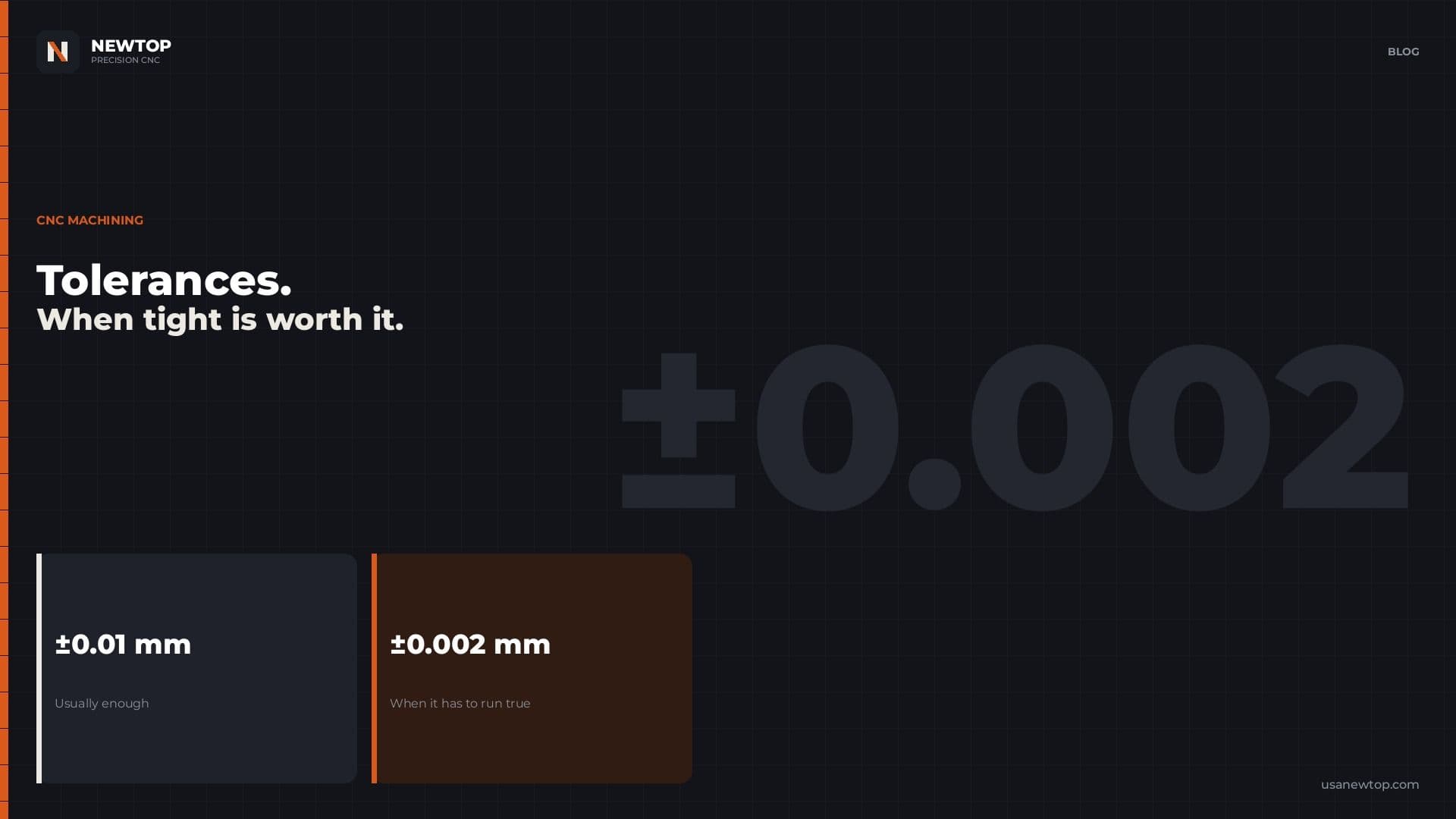
A drawing full of ±0.01 mm looks careful. It is often just expensive.
No process makes the same part twice. A tolerance is the band you will accept so the part still works. Tighter than that, and you buy extra setups, slower feeds, more finishing passes, and a CMM report you may not need.
Newtop machines to ±0.002 mm on Swiss work when the feature earns it. Most features do not.
What a tolerance actually says
25.00 ±0.05 mm means 24.95 to 25.05 mm is good. Outside that, it is scrap — even if the part would have assembled.
Write the loosest number that still lets the product do its job.
Ranges that are real on a CNC floor
±0.10 mm — Covers, bosses, non-mating stock
±0.05 mm — Most brackets, housings, general engineering
±0.02 mm — Fits that have to repeat
±0.01 mm — Bearing seats, precision shafts, locating bores
±0.002 mm — Swiss-turned pins, registers, hubs that must run true
Geometry, alloy, tool wear, and shop temperature all move the result. Aluminum 6061 holds size easily. 316 and titanium make heat. Thin walls walk. Long sticks chatter.
When ±0.01 mm is the right call
Use it on the features that locate, spin, or seal:
- Bearing and bushing seats
- Precision shafts and registers
- Optical / medical interfaces
- High-speed rotating stacks
- Datums that clock an assembly
Do not put it on a cover outline, a logo pocket, or a hole that only holds a cable tie.
When ±0.002 mm is worth it
This is Swiss-turning territory: small diameters, shoulders, threads, and bores that have to stay concentric.
On a UAV hub, bore-to-register concentricity is not a vanity callout. If it is off, the prop tracks an ellipse and the battery pays. Same story on a motor seat that is dished instead of flat — the bearings take a preload nobody designed.
Newtop holds ±0.002 mm on STAR / CITIZEN / TSUGAMI Swiss work. Milled brackets and housings typically hold ±0.01 mm. Lots can be checked on a ZEISS CONTURA (0.9 μm). Dimensional reports ship with the parts when the print asks for them.
What tight numbers cost
Moving a feature from ±0.10 mm to ±0.01 mm is not a rounding change. It usually means:
- Slower cutting
- Extra finish passes
- Better (and shorter-lived) tooling
- CMM instead of a caliper
- Higher scrap
Pay that only on the dimensions that fail the product if they drift.
What to put on the drawing
- Mark the functional features. Give those a real tolerance.
- Let the rest fall under a general block (ISO 2768-m is a start).
- Call out flatness and concentricity where thickness and diameter are not enough.
- Use stock hole sizes. Reamers exist for a reason.
- Give thin walls more than hope.
- Open internal corners so a real end mill can finish them.
Send the drawing or STEP. Say which dims are critical. Quote in one business day.
— Newtop Group
Precision CNC machining. Custom metal parts, machined properly.
Request for quote
Need a part like this machined?
Reviewed by an engineer within 1 business day. AL · SS · brass · titanium · to ±0.002mm.
Request a quote